 NSW Geoscience Metadata
2025
Type of resources
Available actions
Topics
Keywords
Contact for the resource
Provided by
Years
Formats
Representation types
Update frequencies
status
Scale
-

The Critical Mineral Analysis Project data set contains the analysis of a representative collection of the Geological Survey of New South Wales (GSNSW) existing rock and analytical powder collections to support the exploration for critical minerals. Existing pulps and powders from whole rock igneous rocks and mine dump samples were submitted for geochemical analysis to ensure the application of modern analytical techniques with significantly improved precision, detection limits for an extended range of trace elements, including the full complement of rare earth elements. Suites of mineral and rock samples from the Economic Rock and Mineral Collection were also selected for analysis from a variety of deposits, deposit types and regions across NSW. These comprise mineralised rocks and drillcore billets, and aggregates of ore minerals.
-
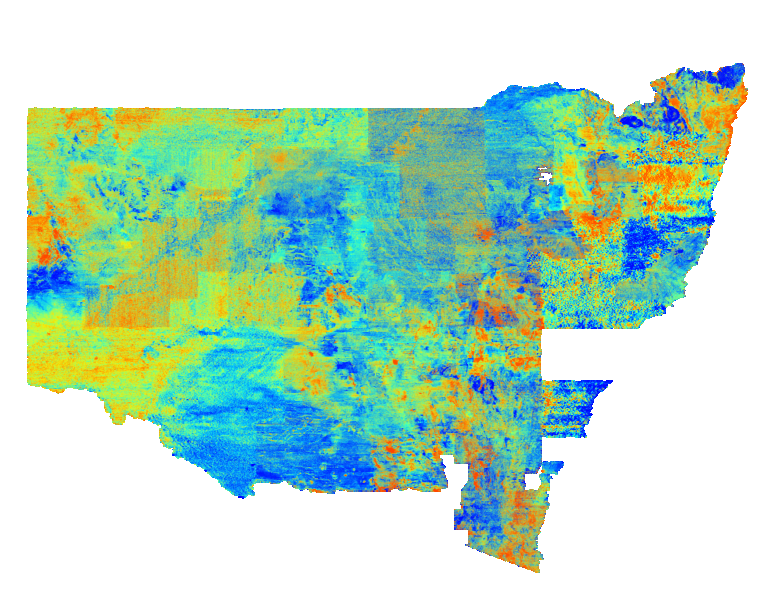
Pseudocolour image of the ratio between uranium and thorium within the upper 20 centimetres of the ground. This image was generated using normalised input grids to avoid ‘divide by zero’ errors. Cooler colours indicate lower abundances of uranium relative to thorium and warmer colours represent the opposite. Variations in U/Th ratio are caused varied mineral compositions in host rocks and soils. This statewide image was generated by merging many individual airborne radiometric surveys.
-

The semi-transparent Bouguer gravity image is displayed using cooler colours (blue) to indicate lower gravity values and warmer colours (red) represent higher values. The underlying greyscale tilt-angle filtered total magnetic intensity image has been reduced to the pole (Tilt TMI RTP). The tilt-angle filter of the total magnetic intensity produces a local positive maximum (white) over a magnetic source and is zero near the edge of the source (grey), and is useful for tracing geological structure below variable depths of cover. Both image layers were generated using a histogram-equalised colour-stretch. Attention: Please ensure your version of the NSW gravity merges contains the date ‘2024-10-30’ in their filename. An update was made to remedy location errors in the initial release. Apologies for any inconvenience.
-

The NSW Mine Reuse project investigated the occurrence of critical metals in mining waste material. It involved a preliminary geochemical and mineralogical characterisation study across multiple metalliferous and coal sites on various waste material types, aiming to identify subsequent secondary prospectivity opportunities. The study was completed in collaboration between the Geological Survey of NSW, the Sustainable Minerals Institute at The University of Queensland, Geoscience Australia and RMIT University. The program consisted of hand-auger drilling and sample collection from various waste sources, including tailings, waste rock, slags, coal rejects and fly ash. Each sample then underwent a 48-element geochemical analysis, with targeted mineralogy and mineral chemistry conducted on selected samples to better understand the distribution of elevated critical elements.
-
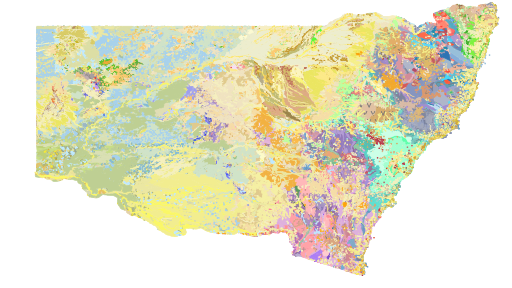
The NSW Seamless Geology Project was originally a five-year initiative of the Geological Survey of New South Wales which commenced in late 2013 and aimed to provide a statewide compilation of the best available digital geological mapping data in an internally consistent format. The overarching aims of the NSW Seamless Geology Project were to: (i) compile the different original scales, formats and rock unit naming conventions into a consistent, statewide format; (ii) edge-match the geology across existing map sheets; and (iii) interpret the basement geology under cover. The resulting geodatabase comprises a series of layers which include: (i) solid basement geology; (ii) cover rocks (defined as undeformed and unmetamorphosed); (iii) Mesozoic igneous rocks; and (iv) Cenozoic sedimentary and igneous rocks. Due to the size of the project, the work was divided into UTM zones, starting in the east with Zone 56, then moving west to Zone 54, and finishing with Zone 55. The western half of Zone 55 was completed in 2018, after which the results were merged with the previously completed Zones to produce version 1 of the NSW Seamless Geology dataset. Completion of this stage saw the end of phase 1 of the Seamless Geology Project, but it is intended that the Seamless Geology dataset will be continually updated and refined as new digital geological mapping data becomes available. Updates to the Seamless Geology dataset generally occur on an annual basis. Version 2.5 is the 7th major update to the NSW Seamless Geology and was released in May 2025. This release includes: a new layer to capture Cenozoic ‘sub-basaltic gravels and deep leads’; significant upgrades to the mapping of numerous areas in the Lachlan Orogen (particularly the Coolac Serpentinite Belt, Gilmore Fault Zone, and the Eden-Merimbula area); a major update to the mapping of the Gunderbooka 1:100,000 map sheet area and the Port Macquarie–Laurieton area; and attribute updates, data additions, and minor error fixes to all layers. NOTE: A substantial amount of overlay, erase and intersect geoprocessing of the original multi-layered Seamless Geology was undertaken to produce the single layer surface NSW Seamless Geology dataset. Due to small tolerance differences between different layers in the Seamless Geology dataset, this has, in some places, created small “sliver” polygons between boundaries common to more than one layer of the original multi-layered NSW Seamless Geology. This is a known issue with the current single layer Seamless Geology dataset and while some attempt has been made to resolve these issues, a number of small “sliver” polygons remain. Users are cautioned to be aware of this problem when using this dataset at high zoom levels (ie. under 1:1,000 scale) and to refer to the full Seamless Geology dataset for clarification.
-

The semi-transparent isostatic residual gravity image is displayed using cooler colours (blue) to indicate lower gravity values and warmer colours (red) represent higher values. The underlying greyscale tilt-angle filtered total magnetic intensity image that has been reduced to the pole (Tilt TMI RTP). The tilt-angle filter of the total magnetic intensity produces a local positive maximum (white) over a magnetic source and is zero near the edge of the source (grey), and is useful for tracing geological structure below variable depths of cover. Both image layers were generated using a histogram-equalised colour-stretch. Attention: Please ensure your version of the NSW gravity merges contains the date ‘2024-10-30’ in their filename. An update was made to remedy location errors in the initial release. Apologies for any inconvenience.
-

Greyscale image of first vertical derivative (1VD) of Bouguer gravity. Darker tones indicate lower values and lighter tones represent higher values. Bouguer gravity compensates for variations in latitude, 'free-air' elevation and Bouguer correction (assuming a crustal density of 2.67 T/m³). Attention: Please ensure your version of the NSW gravity merges contains the date ‘2024-10-30’ in their filename. An update was made to remedy location errors in the initial release. Apologies for any inconvenience.
-

Greyscale image of first vertical derivative (1VD) of isostatic residual gravity (Iso-grav). The 1VD filter shows the rate of change in the isostatic gravity data. Darker tones indicate lower values and lighter tones represent higher values. Attention: Please ensure your version of the NSW gravity merges contains the date ‘2024-10-30’ in their filename. An update was made to remedy location errors in the initial release. Apologies for any inconvenience.
-
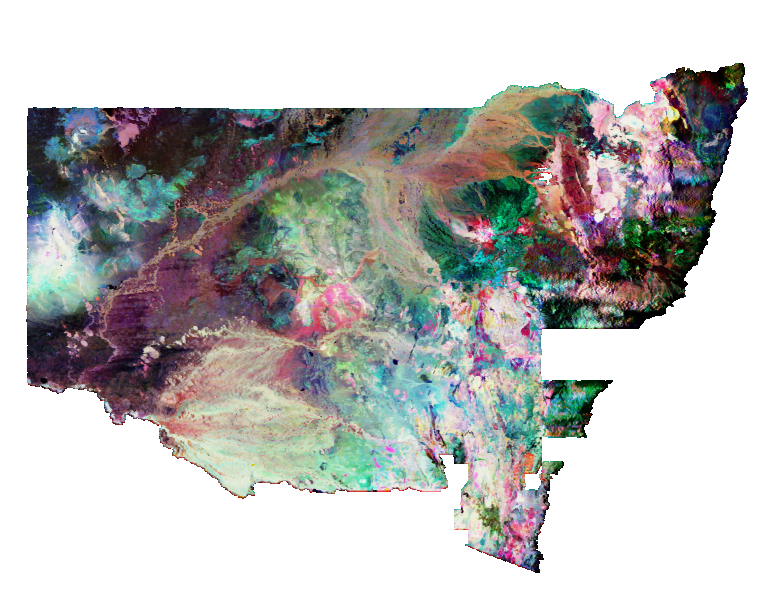
Ternary radioelement potassium(K)-thorium(Th)-uranium(U) channel data. The image was generated by merging many individual airborne surveys and is a red-green-blue (RGB) composite using a histogram-equalised colour-stretch for each of the three channels. The red, green and blue channels represent K, Th and U respectively. Mixed compositions are indicated by the proportional blend of the corresponding additive primary colours (e.g. yellow indicates the presence of both K and Th, magenta the presence of K and U while aqua indicates the presence of Th and U). Black indicates low concentrations and white represents high concentrations for all three radioelements. The distribution of radioelements reflects the geochemistry and mineralogy of the near-surface, which may constitute either bedrock or regolith materials. The NSW statewide grid DVD set includes K values in percent(%), Th values in parts per million (ppm) and U values in parts per million (ppm). This dataset is part of the Geological Survey NSW State Geophysics data set series.
-
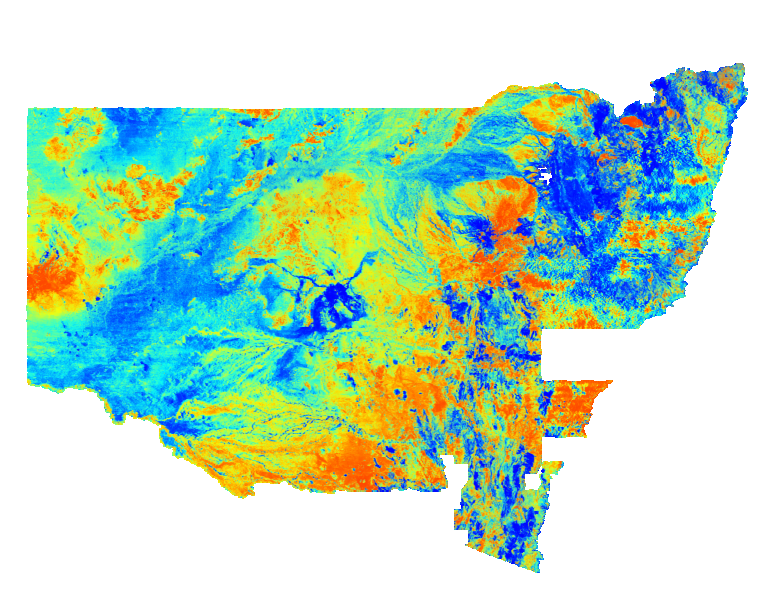
Pseudocolour image of the ratio between thorium and potassium within the upper 20 centimetres of the ground. This image was generated using normalised input grids to avoid ‘divide by zero’ errors. Cooler colours indicate lower abundances of thorium relative to potassium and warmer colours represent the opposite. Variations in Th/K ratio are caused varied mineral compositions in host rocks and soils. This statewide image was generated by merging many individual airborne radiometric surveys.