 NSW Geoscience Metadata
geoscientificInformation
Type of resources
Available actions
Topics
Keywords
Contact for the resource
Provided by
Years
Formats
Representation types
Update frequencies
status
Scale
-
Many airborne surveys have been acquired by the NSW government through the NSW Exploration, Discovery 2000 and New Frontiers Initiative funding. Others have been acquired jointly with Geoscience Australia (formerly AGSO). Contained within this vector file are details on each of the surveys and some acquisition parameters, which will help locate survey data stored digitally.
-
Depth contours derived from the NSW Basement Elevation Model.
-
AEM curtains are a set of cross-sections generated using geophysical inversion to convert AEM data to conductivity (m/S) versus depth below surface (m). These data represent the conductivity of soil and rocks to a depth of about 400 m. A pseudocolour-stretch has been applied to the data. Blue represents low conductivity values and red represents high values. The colours vary due to; (1) natural variations in the electrical properties of soils, rocks, minerals and groundwater, (2) man-made structures, radio-transmissions and lightning strike and (3) AEM system artefacts.
-
In 2016, the Geological Survey of NSW (GSNSW) published a state-wide depth to basement 3D model (Robinson 2016, 2017). Since then, new geological and geophysical data have been released and used for the construction of basin-scale 3D geological models for the southern Thomson Orogen and the Sydney, Gunnedah and Bowen basins (Davidson 2019; Oliveira and Davidson 2019; Oliveira et al. 2019). The basement topography under these regions was modelled using constraints from drillholes, seismic, Seamless Geology, magnetics and gravity data. The results have now been incorporated into the updated Statewide 3D Basement Elevation Model reported herein.
-
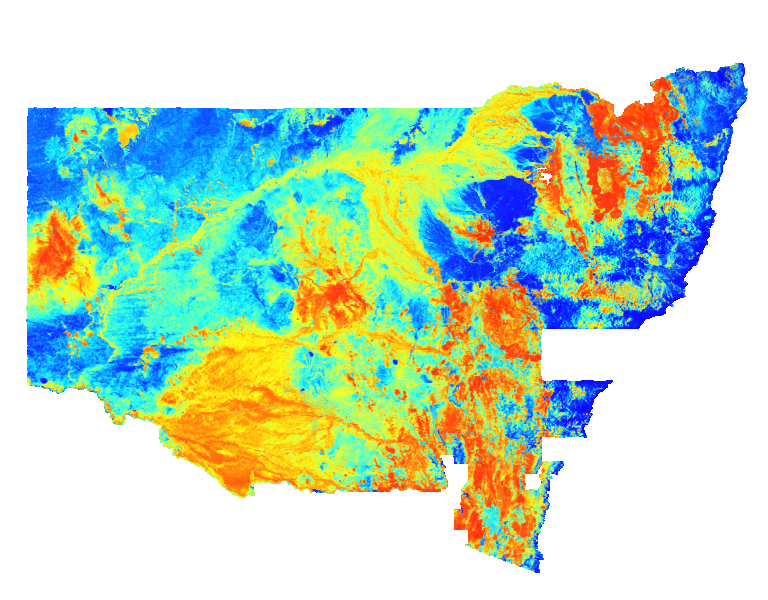
Pseudocolour image of the percentage of potassium (K%) in the upper 20 centimetres of the ground. Cooler colours indicate lower abundances of potassium and warmer colours represent higher abundances. Variations in potassium values are caused by varied mineral compositions in host rocks and soils. This statewide image was generated by merging many individual airborne radiometric surveys.
-
This layer shows the boundaries of each airborne gravity survey acquired by the NSW Government. Details on the spacing and age of the gravity data within each project area are in the attributes. The information contained in this publication is based on knowledge and understanding at time of writing (April 2017). Because of advances in knowledge, users are reminded of the need to ensure that information upon which they rely is up to date. The information contained in this publication may not be or may no longer be aligned with government policy nor does the publication indicate or imply government policy.
-
The Geological Survey of NSW developed a Seamless Geology of UTM Zone 56 during2014 as part of a project to develop a seamless vector geology dataset of the best available geological mapping data covering the whole of NSW.The overarching aims of the Statewide Seamless Geology Project were to: (i) compile the different original scales, formats and rock unit naming conventions into a consistent, statewide format; (ii) edge-match the geology across existing map sheets; and (iii) interpret the basement geology under cover. The resulting geodatabase comprises a series of layers which include: (i) solid basement geology; (ii) cover rocks (defined as undeformed and unmetamorphosed); (iii) Mesozoic igneous rocks; and (iv) Cenozoic sedimentary and igneous rocks. The project was divided into 3 major stages corresponding to the UTM zones which divide New South Wales. This dataset includes the seamless geology layers from the NSW portion of UTM Zone 56 (ie.east of 150 degrees longitude to the coast).
-
An index of 1:250 000 map sheets covering NSW. The index shows maps where the total statewide geophysics package has been clipped and re-imaged to enhance colour stretch for the local regions. Each map sheet suite contains grids and images for up to 40 different layers, including: - Total Magnetic Intensity (TMI) - TMI Reduced to the Pole (RTP) - First Vertical Derivative (1VD) of TMI RTP - Second Vertical Derivative (2VD) or TMI RTP - Tilt Angle Filter of TMI RTP - TMI RTP and TMI RTP Tilt composite - Analytical Signal (AS) of TMI RTP - 250m and 500m Upward Continuations (UC) of TMI RTP - 1VD of TMI RTP UC products - Potassium percentage (Kperc) - Thorium parts per million (Thppm) - Uranium parts per million (Uppm) - Potassium-Thorium-Uranium ternary (KThU) - Zero mean normalised Kperc - Zero mean normalised Thppm - Zero mean normalised Uppm - Dose Rate - Uranium squared divided by Thorium (U2/Th) - Thorium divided by Potassium (Th/K) - Uranium divided by Potassium (U/K) - Uranium divided by Thorium (U/Th) - Airborne & Ground Bouguer gravity - Airborne & Ground Bouguer gravity and TMI RTP Tilt composite - Airborne & Ground Bouguer gravity 1VD - Airborne & Ground Isostatic gravity - Airborne & Ground Isostatic gravity and TMI RTP Tilt composite - Airborne & Ground Isostatic gravity 1VD - Digital Elevation Model (DEM) - Terrain colour stretch - Pseudocolour colour stretch - Greyscale colour stretch
-
Isostatic residual Bouguer gravity image overlain on tilt-filtered total magnetic intensity reduced to the pole (Tilt TMI RTP) image. The image is a partially-transparent pseudocolour layer of Isostatic residual Bouguer gravity, with a histogram-equalised colour-stretch, overlain on a greyscale intensity layer of the Tilt TMI RTP, with a histogram-equalised stretch. Bouguer gravity compensates for variations in latitude, 'free-air' elevation and Bouguer correction (assuming a crustal density of 2.67 T/m³). The isostatic correction removes the effect of variations in the thickness of the Earth’s crust due to changes in topography. The tilt-angle filter of total magnetic intensity produces a local positive maximum over a magnetic source and is zero near the edge of the source, and is useful for tracing geological structure below variable depths of cover.
-
Marine protected areas are parts of the NSW marine estate managed to conserve marine biodiversity and support marine science, recreation and education. The NSW system of marine protected areas includes: marine parks – six multiple use marine parks cover around one third (approximately 345,000 hectares) of the NSW marine estate aquatic reserves – 12 aquatic reserves cover around 2,000 hectares of the NSW marine estate national parks and nature reserves – include around 20,000 hectares of estuarine and oceanic habitats.