 NSW Geoscience Metadata
NSW basement topography
Type of resources
Available actions
Topics
Keywords
Contact for the resource
Provided by
Representation types
Update frequencies
status
Scale
-
Depth contours derived from the NSW Basement Elevation Model.
-
In 2016, the Geological Survey of NSW (GSNSW) published a state-wide depth to basement 3D model (Robinson 2016, 2017). Since then, new geological and geophysical data have been released and used for the construction of basin-scale 3D geological models for the southern Thomson Orogen and the Sydney, Gunnedah and Bowen basins (Davidson 2019; Oliveira and Davidson 2019; Oliveira et al. 2019). The basement topography under these regions was modelled using constraints from drillholes, seismic, Seamless Geology, magnetics and gravity data. The results have now been incorporated into the updated Statewide 3D Basement Elevation Model reported herein.
-

In 2023, the Geological Survey of NSW (GSNSW) engaged Geognostics to perform a review and update of the previous OZ SEEBASE 2021. Previous SEEBASE® studies of NSW basins undertaken by Frogtech Geoscience were undertaken over 15 years ago, and significant new data have been acquired since that time (drillholes, gravity, magnetics, seismic, etc.), along with on-going research and consolidation of statewide interpretations undertaken by the Geological Survey of NSW (GSNSW; i.e., the Seamless Geology Map of NSW by Colquhoun et al., 2022).
-
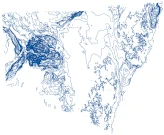
In 2023, the Geological Survey of NSW (GSNSW) engaged Geognostics to perform a review and update of the previous OZ SEEBASE 2021. Previous SEEBASE® studies of NSW basins undertaken by Frogtech Geoscience were undertaken over 15 years ago, and significant new data have been acquired since that time (drillholes, gravity, magnetics, seismic, etc.), along with on-going research and consolidation of statewide interpretations undertaken by the Geological Survey of NSW (GSNSW; i.e., the Seamless Geology Map of NSW by Colquhoun et al., 2022).
-

Depth to the Mohorovičić discontinuity (Moho) interpreted and modelled by Geognostics with support from government and industry. The Moho surface is the boundary between the Earth's crust and the upper mantle. The depth to moho is a representation of the thickness of the Earth's Crust. This moho surface is derived from seismic, gravity and other geophysical datasets.
-

Geothermal gradient model (2023) created by Geognostics with support from government and industry. The geothermal gradient describes how temperature increases with depth inside the Earth. It is expressed in degrees Celsius per kilometre (°C/km). The linear geothermal gradients are from the top of SEEBASE to the surface. These were calculated using the combined heat-flow contribution of multiple crustal heat sources including upper mantle, radiogenic upper crust, and sediment thickness. The highest calculated geothermal gradients are generally related to areas interpreted to be underlain by granitic intrusions in the basement. The composition and heat production characteristics of the granites are largely unconstrained by analyses
-

Depth to the Lithosphere–Asthenosphere Boundary (LAB) modelled by Geognostics with support from government, academia and industry. The LAB surface is the base of the ridgid lithosphere and the top of the ductile asthenosphere. In geothermal terms it marks a thermal and mechanical tranisition in the Earth at a temperature of 1330 °C. This surface is modelled using themal modelling (mantle heat flow, crustal heat production, thermal conductivity, Moho depth and lithospheric structure) seismic tomography, magnetotellurics, global and regional geodynamic models and tectonic context.
-

Basement terrane age interpreted by Geognostics with support from government, academia and industry. Geological age of Basement terrane age is interpreted from a combination of geological and geophysical datasets. Basement terrane age is important in a Geothermal studies as older terranes have lower heat potential.
-

Basement type interpreted by Geognostics with support from government, academia and industry. The basement type describes the geological processes that has produced each basement block
-

Total heat flow at surface model (2023) created by Geognostics with support from government and industry. This model is the sum of all heat-flow contributions (mantle heat flow, lower crustal heat flow, upper crustal radiogenic heat flow and sedimentary heat flow). This is modelled using a bottom up approach starting from the mantle and calculating upwards: Qtotal = Qmantle + Qlowercrust + Qupper crust + QSediments Basement composition and terranes dominate total heat flow, especially where sediment cover is thin. Where sediments are thick then these sediments mute the basement signatures. The total heat flow patterns closely follow upper crustal radiogenic heat production.